 how-to
How to Implement AAC in Elementary Classrooms
Last Updated: November 5, 2026
Quick Summary
To learn how to implement aac in elementary classrooms, start by giving students access to their AAC system all day, placing core vocabulary boards on each desk, table, and carpet spot and keeping a second copy near the door. Then model without expectation by pointing to symbols while you talk, and build communication opportunities into circle time, snack, play, and transitions.
- Check device batteries and charging every morning, and confirm switch access works before the first lesson.
- Model without expectation: point to symbols while you talk without asking the student to copy you.
- After you model, count silently to five to give students time to respond.
- Keep a low-tech picture board as backup and report broken devices the same day.
- Pick one routine and review your notes every two weeks with your team.
Table of Contents
- Step 1: Set Up Your AAC Communication System and Classroom Access
- AAC Modeling Strategies for Teachers: Model Without Expectation
- AAC Classroom Activities and Examples for Circle Time, Snack, and Play
- AAC Communication Opportunities During Daily Routines and Transitions
- Troubleshooting Barriers and Family Collaboration
- Tracking Progress Without Overwhelm
- Frequently Asked Questions
Step 1: Set Up Your AAC Communication System and Classroom Access
Learning how to implement AAC in elementary classrooms starts with access. An AAC system is any tool a student uses to communicate beyond speech, from a picture board to a speech-generating device (Augmentative and Alternative Communication in Early Intervention). The system works when it lives within arm's reach all day, not in a cupboard.
Here is how to set up access in your room:
- Place a core vocabulary board on each desk, table, and carpet spot.
- Keep a second copy near the door for transitions.
- Check device batteries and charging every morning.
- Store backup picture symbols in a labeled folder.
- Confirm switch access works before the first lesson.
A common mistake is treating AAC as a special education tool only. Every adult in the room needs to reach it.
If you are building boards from scratch, these printable AAC boards for schools give you a ready starting point you can print and place around the room.
Here is the access setup the article recommends for your classroom.
| Setup task | What to do |
|---|---|
| Core vocabulary board | Place on each desk, table, and carpet spot |
| Second copy | Keep near the door for transitions |
| Device batteries | Check and charge every morning |
| Backup picture symbols | Store in a labeled folder |
| Switch access | Confirm it works before the first lesson |
AAC Modeling Strategies for Teachers: Model Without Expectation
The fastest way to build communication skills is to model without expectation. AAC modeling means pointing to symbols while you talk, without asking the student to copy you. No quizzes, no pressure, no "say it back."
Many teachers find this hard at first. Modeling feels slow, and it is tempting to prompt a response. But students learn the system by watching us use it, the same way they learn spoken words.
Try these habits:
- Point to "more" as you pour juice.
- Touch "help" when you open a tricky jar.
- Model "finished" at the end of a task.
- Use the student's device during your own instructions.
A common mistake is modeling only during speech sessions. The classroom team should model all day, every day.
If you want more detail on this approach, our guide on how to use AAC modeling strategies as a paraprofessional walks through it step by step. You can also grab five easy ways to model AAC during the school day with a free printable sample.
AAC Classroom Activities and Examples for Circle Time, Snack, and Play
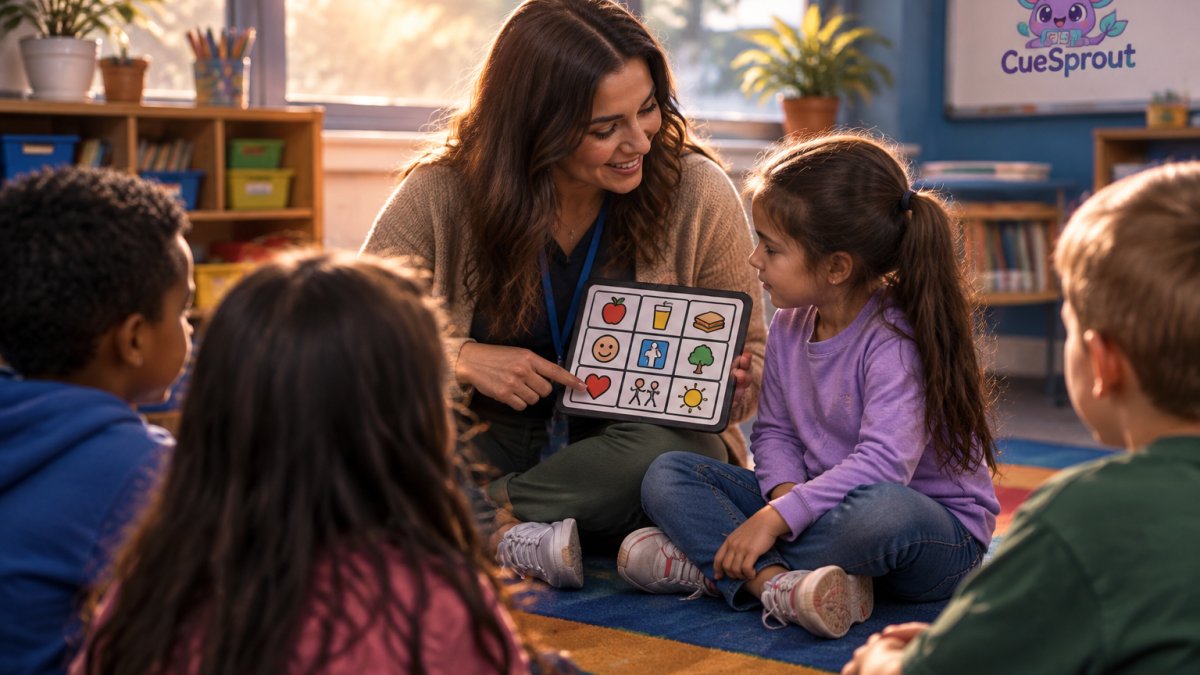
The best AAC classroom activities and examples fit inside what you already do. You do not need new lessons, just communication opportunities built into the ones you have.
- Circle time: model "more" during songs and "stop" to end an activity.
- Snack: offer two choices and wait for a point or symbol.
- Play: model "my turn" and "look" during block building.
- Story time: pause and model "again" after a favorite page.
Wait time matters more than anything. After you model, count silently to five. Students with complex communication needs often need that pause to respond.
For more classroom-ready ideas, these visual supports for elementary students cover seven practical wins.
AAC Communication Opportunities During Daily Routines and Transitions
Transitions are where communication quietly disappears. Lining up, handwashing, and packing up are fast, and talking stops. That is exactly where to add AAC communication opportunities during daily routines.
Try these moments:
- Model "go" before the class walks to lunch.
- Offer a choice board at the coat rack.
- Model "finished" when a lesson ends.
- Use a first-then board for tricky transitions.
A common mistake is skipping AAC during busy moments because it feels faster. Those minutes add up to dozens of chances each day, so keep your device available even when you are rushed.
Our Educator Hub has free routine examples and a quick-start guide for embedding AAC into transitions and daily routines.
Troubleshooting Barriers and Family Collaboration
Two things trip up most classrooms: device failures and the home-school gap. Plan for both before they happen.
For device trouble:
- Keep a low-tech picture board as backup.
- Write down charging steps for every adult.
- Report broken devices the same day.
For families, share the same symbols you use at school, and send a short weekly note home. When home and school model the same words, students make faster progress.
Tracking Progress Without Overwhelm
You do not need a complex system to measure progress. Pick one routine and watch for small changes.
- Note new symbols a student uses.
- Track how often adults model each day.
- Record wait time after modeling.
- Review notes every two weeks with your team.
Small wins count. A student who points to "more" once is showing you the system works.
Frequently Asked Questions
How can I implement AAC in my classroom without formal training?
Start small. Pick one daily routine, like snack time, and place a picture board or communication book where everyone can reach it. Model one or two words while you talk, then wait a few seconds. You do not need to know every symbol. CueSprout's adult modeling guides and planning forms give you a shared starting point.
How do I model AAC during classroom activities without pressuring students to respond?
Model without expectation. Point to symbols as you speak, then give wait time of five to ten seconds. If the student does not respond, move on warmly. The goal is exposure and connection, not a correct answer. Try modeling during play-based learning, story time, or transitions. Over time, many students begin to join in on their own terms.
What are some effective AAC communication opportunities during daily routines?
Look for moments that already happen every day: arrival, circle time, snack, math centers, literacy blocks, and transitions. Offer choices, comment on what you see, and pause to let the student share. Keep the communication system available at all times, not locked in a cabinet. Consistent use across routines builds expressive communication and self-expression without adding extra lessons.
Getting started with AAC can feel like one more task on a full plate. It does not have to be. CueSprout gives you ready-to-use printables, adult modeling guides, and planning forms that drop straight into your existing routines. Try one board this week, model without pressure, and let connection lead the way. Get a free sample from CueSprout and see how quickly communication becomes part of every lesson.