 how-to
How to Use AAC Modeling Strategies as a Paraprofessional
Last Updated: October 28, 2026
Quick Summary
AAC modeling means pointing to and using a student's communication system while you talk, so they see how it works in real time. As a paraprofessional, you show rather than test: tap the button, say the word, pause, then respond. Spread short modeling moments across the whole school day.
- Model words during snack, math, line-up, story time and cleanup routines you already do.
- Write a short script: say the words, touch the buttons, pause and count to five.
- Aim for 2 models at arrival, 2-3 per lesson block and 3-4 at snack and lunch.
- For students needing more support, model one word at a time and accept any communication attempt.
- Avoid treating the device like a test by asking students to find words on demand.
Table of Contents
- What AAC Modeling Means and Why Paraprofessionals Are Key
- AAC Modeling Examples in the Classroom You Can Copy Today
- AAC Modeling Scripts for Paraprofessionals: What to Say and Touch
- How Often to Model AAC During a School Day
- AAC Partner Strategies for Students Who Need More Support
- Common Mistakes Paraprofessionals Make with AAC Modeling
- Get a Free Sample and Start Modeling This Week
- Frequently Asked Questions
What AAC Modeling Means and Why Paraprofessionals Are Key
AAC modeling is the act of pointing to and using a student's communication system while you talk, so the student sees how it works in real time. This guide breaks down practical aac modeling strategies for paraprofessionals that fit into a normal school day. The short version: you show, you don't test.
That distinction matters more than any tool or app.
The difference between testing and modeling
Testing looks like this: "Show me 'more.' Where's 'more'?" Modeling looks like this: you tap "more" on the student's board while saying, "More crackers, please." Then you hand over the crackers.
One puts a student on the spot. The other shows them the path. The American Speech-Language-Hearing Association's guidance on AAC describes modeling as a core partner skill, not an assessment task.
Why your role matters more than you think
That's a lot of small moments, and small moments add up.
You don't need to be the expert. You need to be consistent. If you want a deeper walkthrough of classroom steps for non-speaking learners, see our guide on AAC strategies for non speaking learners.
AAC Modeling Examples in the Classroom You Can Copy Today
Here are AAC modeling examples in the classroom you can use. Each one fits inside something you're already doing.
- Snack time: Tap "want" + "apple" while asking, "Do you want apple?"
- Math block: Point to "more" and "help" while handing out manipulatives.
- Line-up: Model "go" and "stop" as the class moves through the door.
- Story time: Tap "turn" on the page-turn, then "read" before you start.
- Cleanup: Model "finished" as you put materials away.
They attach to routines that already exist.
Pair these with visual supports. Our post on AAC visual supports for elementary students has seven classroom-ready ideas that work alongside modeling.
AAC Modeling Scripts for Paraprofessionals: What to Say and Touch
An AAC modeling script is a short, repeatable line you say while touching specific buttons on a student's system.
Here's a simple format you can fill in for any activity:
Activity: ______ Say: "[Word] + [word], please." (example: "Help me, please.") Touch: [button 1] + [button 2] Pause: Count to five. Wait for any response. Then: Hand over the item or complete the action.
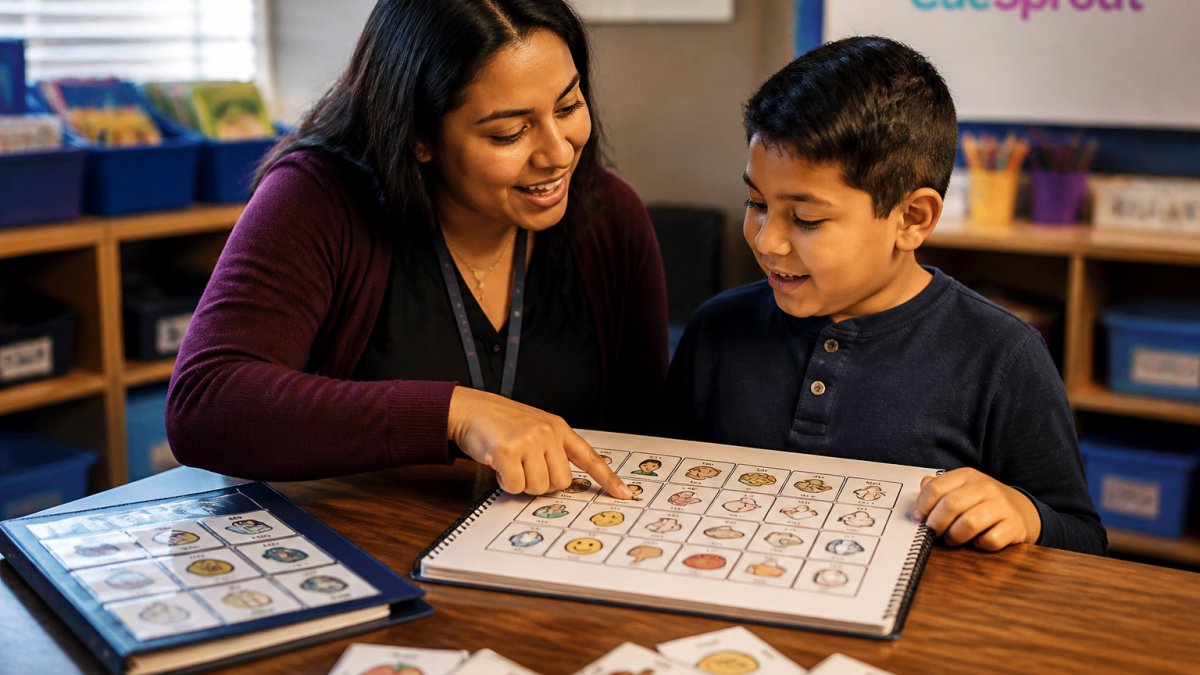
Give the student room to respond in any way, including a look, a reach, or a sound.
You can model words the student doesn't know yet. If you're weighing whether pre-made scripts save time, our article on ready-to-use AAC modeling guides covers what to look for.
How Often to Model AAC During a School Day
Aim for short modeling moments spread across the whole day rather than one long session.
A workable rhythm for a paraprofessional:
- Arrival: 2 models (greeting, "want")
- Each lesson block: 2-3 models tied to the activity
- Snack and lunch: 3-4 models (food, "more," "finished")
- Transitions: 1-2 models ("go," "stop," "wait")
- Pack-up: 2 models ("finished," "bye")
If planning that feels heavy, our AAC lesson plan templates for elementary students give you a structure to slot them into.
Here is a workable daily rhythm for spreading short modeling moments across the school day.
| Part of day | Number of models | Example words |
|---|---|---|
| Arrival | 2 models | greeting, "want" |
| Each lesson block | 2-3 models | tied to the activity |
| Snack and lunch | 3-4 models | food, "more," "finished" |
| Transitions | 1-2 models | "go," "stop," "wait" |
| Pack-up | 2 models | "finished," "bye" |
AAC Partner Strategies for Students Who Need More Support
These AAC partner strategies for students who need more support focus on reducing pressure and increasing predictability.
- Model one word at a time before combining words.
- Use the same phrase every time for a routine, so it becomes predictable.
- Pair the button with the real object whenever you can.
- Accept any communication attempt as valid, including gestures and sounds.
- Reduce the field by covering unused buttons if the board feels overwhelming.
Slow down instead. Fewer words, more pauses.
For students placed in general education rooms, our guide on supporting non-speaking students in general education covers setting-specific strategies that pair well with modeling.
Common Mistakes Paraprofessionals Make with AAC Modeling
The biggest mistake is treating the device like a test. "Find the word 'bathroom'" puts pressure on a student who is still learning. Model it instead: tap "bathroom" on the way out the door.
Other frequent slips:
- Modeling only at scheduled times. Real learning happens in unplanned moments.
- Skipping the pause. Rushing past the wait kills the response window.
- Hiding the system away. A device in a cabinet can't be modeled.
- Correcting instead of showing. Point to the right word and move on.
- Doing it alone. Teachers and paraprofessionals need the same scripts, or the student gets mixed signals.
Get a Free Sample and Start Modeling This Week
Pick one routine tomorrow, write one script, and model it three times.
CueSprout makes that easier with ready-to-use AAC printables, adult modeling guides, and planning forms built for general and special education classrooms. Our materials give teachers and paraprofessionals a shared starting point. They support integrating communication opportunities into math, literacy, and daily routines.
Get started with CueSprout and grab a free sample.
Frequently Asked Questions
What does it mean to model AAC?
Modeling AAC means you point to or tap words on a student's communication system while you speak, without asking the student to repeat or respond. You are showing how the system works in real conversations. For example, you say 'I want juice' and touch the pictures for 'I,' 'want,' and 'juice' as you talk. The student watches and learns that those symbols carry meaning. Think of it as talking with your hands on the device, the same way you would point to a picture in a book while reading aloud.
How often should a paraprofessional model AAC during the school day?
Aim to model during natural moments rather than saving it for one special time. Try to model at least a few times during each activity: morning greeting, snack, math, reading, and transitions. For example, model 'help' when opening a snack, 'more' during a game, and 'finished' at cleanup. Consistency matters more than length, so build modeling into routines you already do.
Should adults speak while modeling on an AAC device?
Yes. Speak naturally while you touch the symbols. Say the word out loud as you point to it, then continue your sentence. For instance, say 'Look, the ball is big' and touch 'ball' and 'big' as you talk. You do not need to slow down every word or turn modeling into a lesson. Keep your tone normal and warm. The goal is for the student to see and hear communication happening together, not to quiz them on the symbols.
What should I do after modeling a word on an AAC device?
Pause and give the student time to respond, then continue the activity whether or not they answer. You can also model the same word again later in a different context. For example, after modeling 'open' for a door, model 'open' again for a snack container. Avoid asking 'Can you say it?' or taking the student's hand to touch the device. If the student does respond, accept any communication attempt, including a look, a gesture, or a different word, and respond to the meaning. Keep modeling without pressure.