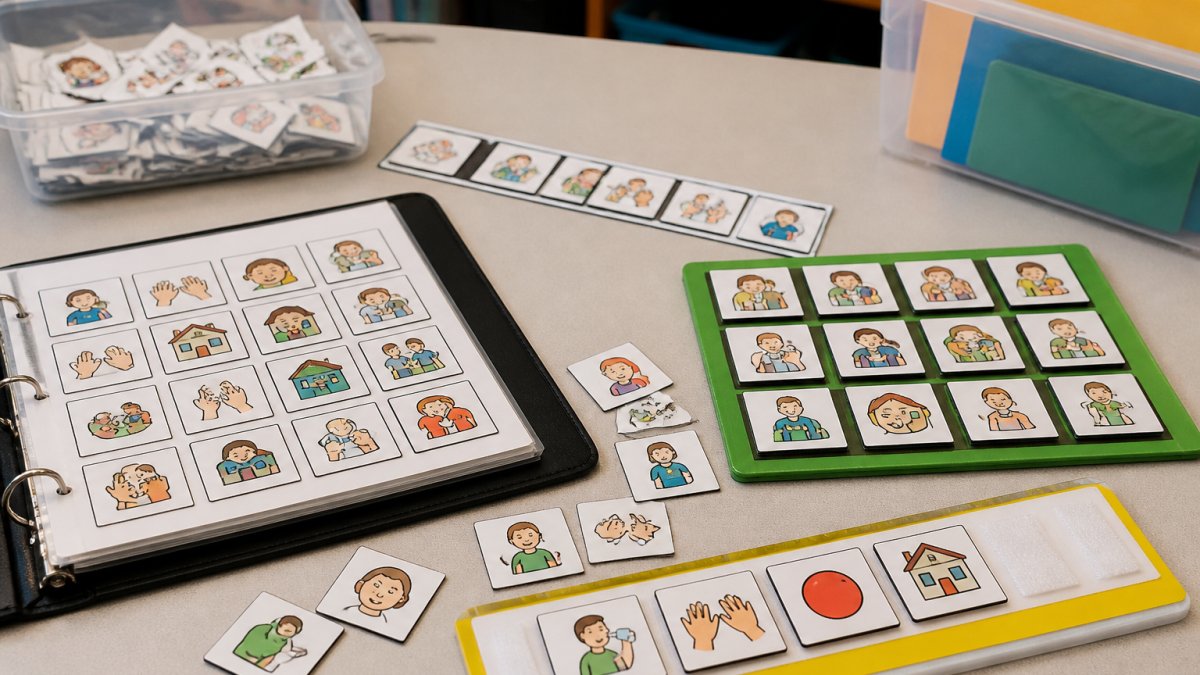
 blog
AAC Lesson Plan Templates for Elementary Students
Table of Contents
- Why AAC Lesson Plan Templates Make Inclusion Doable
- What Goes Into an AAC Lesson Planning Template
- AAC Modeling Strategies for Teachers and Paraprofessionals
- AAC Lesson Plan Examples You Can Copy This Week
- AAC Activities for Elementary Students Across the School Day
- Adapting Templates for Different Access Methods and Support Needs
- Tracking Communication Goals and Progress Monitoring
- Conclusion
- Frequently Asked Questions
Last Updated: October 21, 2026
Why AAC Lesson Plan Templates Make Inclusion Doable
That gap between intention and action is where most classrooms get stuck.
Here is what most guides get wrong. They hand you a long list of strategies with no structure to hang them on.
Below, we walk through what belongs in an AAC lesson planning template, show two examples you can copy this week, and explain how to adapt everything for different students.
What Goes Into an AAC Lesson Planning Template
A good AAC lesson planning template captures five things: the lesson goal, the target vocabulary, the modeling plan, the communication opportunities, and the way you will check progress.
AAC modeling means an adult points to or taps words on the student's system while talking, without demanding a response. It is the single most important habit a plan should build in.
The Planning Fields That Matter Most
Most templates are too long. A one-page form that gets filled in beats a five-page form that sits blank. Here are the fields worth keeping, in the order they appear on a usable form:
- Student and date so the plan has an owner
- Lesson and subject so it connects to real curriculum
- Lesson objective written as what the student will do, not what the adult will teach
- Target vocabulary: three to five words, no more
- Materials needed so nothing is hunted down mid-lesson
- Activity steps in plain order: warm-up, main activity, wrap-up
- Modeling plan: who models, when, and how often
That is ten fields, and it still fits on one page if you keep the boxes small. The order matters: objective first, vocabulary second, materials third, steps fourth, supports fifth, data last. When teachers fill the form in that order, the AAC piece stays attached to the lesson instead of becoming an afterthought.
A Fill-In Template You Can Copy
Here is the same structure as a blank form. Copy it into a document, a shared drive, or a printed page.
AAC Lesson Plan, One Page
- Student: ______ Date: ______
- Subject and lesson: ______
- Objective: The student will ______ during ______.
- Target words (3-5): ______
- Materials: ______
- Activity steps: 1) ______ 2) ______ 3) ______
- Who models and when: ______
- Communication opportunities (list 3): ______
Why These Fields and Not Others
A template is a tool for a busy adult, not a compliance document. The fields above are the ones that change what happens in the room.
The other reason to keep the form short is that a paraprofessional should be able to pick it up and run the lesson without a meeting. If the form needs a meeting to explain it, it is too long.
AAC Modeling Strategies for Teachers and Paraprofessionals
Modeling is the strategy that changes outcomes fastest, and it costs nothing but attention. The rule we give every team is simple: model without testing. You are showing how the system works, not quizzing the student.
Try these approaches:
- Model one word more than the student uses. If they say one word, you say two. This is called language expansion.
- Narrate your own actions. "I'm getting the glue. Glue. My turn."
- Model during transitions. Lining up, washing hands, and packing up are full of repeatable words.
- Keep the device or board within reach all day. A system in a cupboard teaches nothing.
- Share the modeling job. Write down who models during which block so it is not always one adult.
For a fuller picture of how aided language input works, the American Speech-Language-Hearing Association's guidance on AAC is a solid, plain-language starting point to share with your team.
AAC Lesson Plan Examples You Can Copy This Week
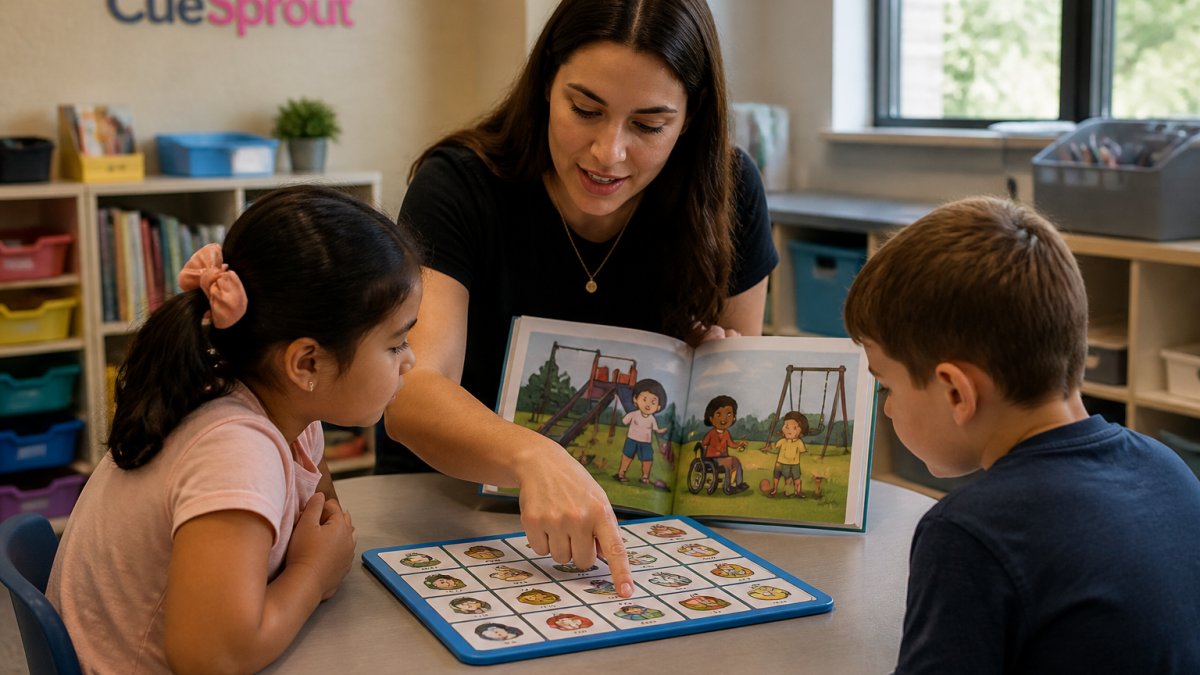
Both examples below use the same one-page template from the previous section. Copy them, swap in your student's words, and you have a plan in ten minutes.
Literacy Block Example (Grades K-2)
Target words: turn, look, more, like, stop.
Modeling plan: The teacher models each target word twice per page while reading aloud.
Communication opportunities: Three per book, built into the story: choosing the next book, asking for a page turn, and commenting on a picture.
Prompt level: Wait five seconds, then point to the word. Fade the point by week three.
Progress note: Did the student use any target word without a prompt? Yes or no.
Math Block Example (Grades 1-3)
Goal: The student will use number and action words during a sorting activity, with at least two unprompted uses per session by Friday.
Target words: more, same, put, finished, help.
Modeling plan: Model during the teacher's demonstration, then again as each group rotates.
Communication opportunities: Asking for materials, saying "finished," and comparing two groups of objects.
Prompt level: Verbal cue first, then a point to the word.
Progress note: Count how many unprompted uses happened.
Science Example (Grades 2-4)
Target words: look, wet, dry, more, what.
Modeling plan: The teacher models "look" and "wet" while demonstrating. The paraprofessional models "what" when the student points at a new object.
Communication opportunities: Predicting what will happen, describing what changed, and asking "what" about a new material.
Prompt level: Point to the word, then wait. Fade to a verbal cue by week two.
Progress note: One line on which target word the student used most.
Social Studies Example (Grades 3-5)
Goal: The student will answer a "who" or "where" question during a map or community lesson, using a target word with no more than one prompt.
Target words: who, where, here, go, help.
Modeling plan: The teacher models "who" and "where" during the lesson read-aloud. The paraprofessional models "here" and "go" while pointing at the map.
Communication opportunities: Naming a person in the lesson, pointing to a place on the map, and saying "go" during a movement break.
Prompt level: Verbal cue first, then a point to the word.
Progress note: Count prompted versus unprompted answers.
Classroom Routine Example (Any Grade)
Goal: The student will use a routine word during morning meeting or cleanup, with at least one unprompted use per day by the end of the week.
Target words: hello, my turn, finished, help, more.
Modeling plan: The teacher models "hello" and "my turn" during morning meeting. The paraprofessional models "finished" and "help" during cleanup.
Communication opportunities: Greeting a peer, taking a turn, signaling the end of a task, and asking for help with a bin.
Prompt level: Wait five seconds, then point. Fade by week three.
Progress note: Tally unprompted uses on the form itself.
Adapting These Examples by Grade and Communication Stage
The same lesson can serve a kindergartner and a fifth grader if you change three things: the vocabulary size, the number of communication opportunities, and the prompt level.
If you are not sure which stage a student is at, ask the speech-language pathologist for a one-line description to keep with the plan. That line is enough to keep the whole team consistent.
AAC Activities for Elementary Students Across the School Day
AAC activities for elementary students work best when they ride along with what the class is already doing. You do not need a separate session. You need a few reliable routines.
- Morning meeting: model "hello," "my turn," and feeling words
- Learning centers: put a board at each station with three words for that task
- Sensory experiences: model "wet," "dry," "more," and "stop"
- Snack and lunch: a natural home for "want," "more," and "finished"
- Recess: model "my turn," "go," and "help"
- Seasonal and thematic activities: swap in words like "cold," "leaf," or "costume"
Hands-on learning gives you objects to talk about, and objects give you words to model. A bin of dry leaves is a vocabulary lesson waiting to happen.
Adapting Templates for Different Access Methods and Support Needs
The same template works for every student if you adapt three fields: access method, vocabulary size, and prompt level.
Access method means how the student operates their system.
Vocabulary size should match the student. A student using a few symbols needs a tight set of three words.
Prompt level should be written down and faded on purpose. If the plan says "point to the word," write when you will try a verbal cue instead.
Tracking Communication Goals and Progress Monitoring
Progress monitoring does not need a spreadsheet. It needs a number you can count in the moment and a place to put it.
Pick one measure per week:
- Unprompted uses of a target word
- Number of communication opportunities offered
- Level of prompting needed by Friday
- One short note on what worked
Keep the note to a single line. "Modeled 'more' six times, student used it twice unprompted" tells you more than a paragraph of description.
The IRIS Center's resources on progress monitoring explain how to collect this kind of data without it taking over your planning time.
Conclusion
The hardest part of AAC in the classroom is not the technology, it is finding a plan that a busy teacher and a paraprofessional can both follow.
That is exactly what we built CueSprout for. Our ready-to-use AAC classroom printables and lesson plans come with adult modeling guides and planning forms, so your team has a shared starting point instead of a blank page.
Frequently Asked Questions
What are the key parts of an AAC lesson plan?
A workable AAC lesson plan covers a few essentials: the target vocabulary (often core words like go, more, stop, help), a communication goal written in plain language, the activity you'll run, and how you'll model the words on the student's AAC system. It should also note the student's access method, any prompts you'll use, and a simple way to record what happened. You don't need a long document. A one-page AAC lesson plan template with those fields is enough to keep modeling consistent across teachers, paraprofessionals, and speech therapy sessions.
How do you model AAC during a lesson?
Modeling means you use the AAC system yourself while you talk, without asking the student to copy you. Point to or tap the word as you say it, then keep going with the lesson. Aim for a few words per activity rather than a whole sentence, and repeat the same core words across the day. This is sometimes called aided language input. Teachers often worry about slowing the lesson down, but modeling takes seconds and gives students a visual example of how communication works. Start with two or three words tied to the activity.
Can general education teachers include AAC in a regular classroom lesson?
Yes, and it doesn't require a separate curriculum. Pick one or two core words that fit what you're already teaching, model them during the lesson, and build in a pause where students can respond with their AAC system. A read-aloud, a math sorting task, or a morning routine all work. The key is planning the communication opportunity in advance rather than hoping it happens. An AAC lesson planning template helps here because it forces you to name the word, the moment, and the model before the lesson starts.
How do I adapt AAC activities for students with different access needs?
Adapt the access method, not the goal. A student using eye gaze, a switch, or a large-key board can work on the same core words as a student tapping a tablet. Reduce the number of choices on the screen or board, position the system where the student can reach or see it, and give extra wait time before prompting. Check with the student's speech-language pathologist about the access method already in place so your classroom materials match what the student uses in therapy. Same vocabulary target, different way in.